Can You Bring a Flashlight on a Plane? TSA Rules
Yes, in carry-on and checked bags. But spare 18650s and other lithium cells must ride in the cabin with terminals protected. The 2026 TSA + FAA rules.
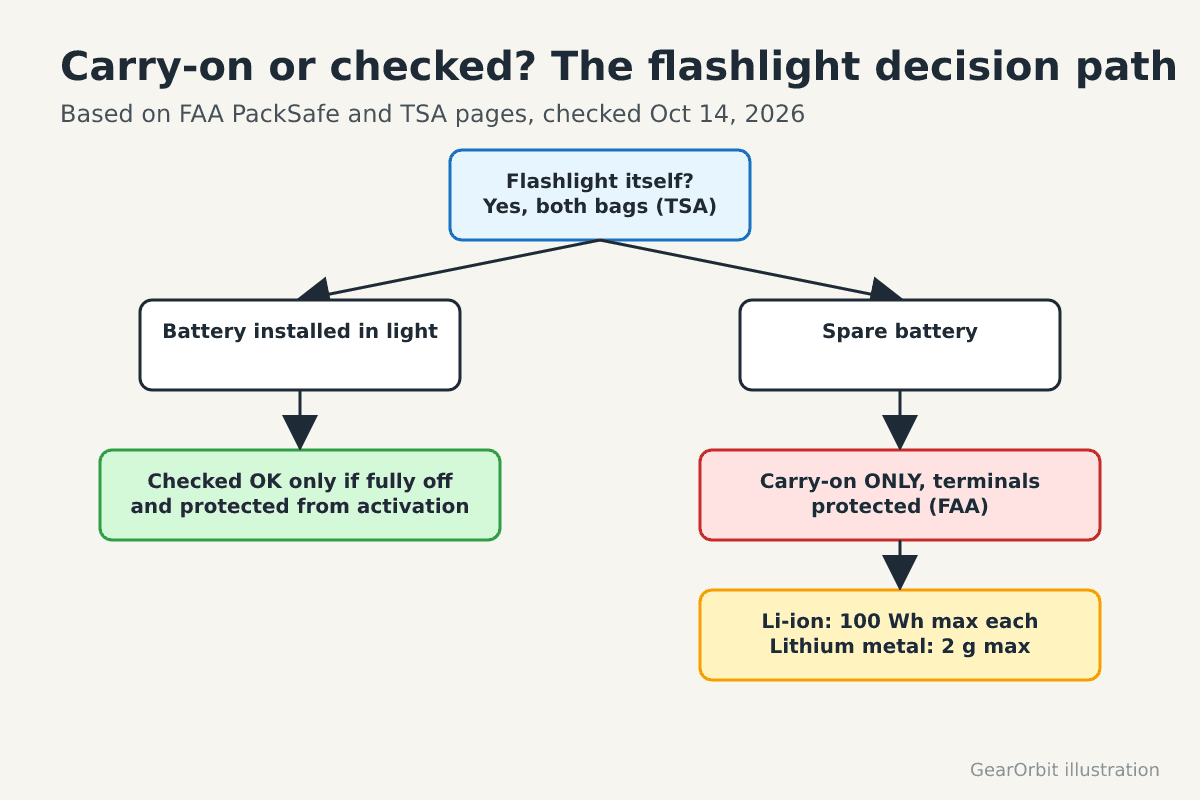
Yes. The TSA allows flashlights in both carry-on and checked bags, though the officer at the checkpoint has the final say. The rules that matter are about the battery. Spare lithium cells, like an extra 18650, can only go in your carry-on, with the terminals protected. Each rechargeable cell is limited to 100 Wh. Between 101 and 160 Wh you need airline approval, and you can carry no more than two spares. A light with its battery installed can go in a checked bag only if it's fully off and can't switch on by accident.
The short version
- The flashlight can go in either bag. A TSA officer makes the final call.
- Spare batteries go in your carry-on only, with the terminals covered.
- Li-ion cells must be 100 Wh or less. Lithium metal cells like CR123A must have 2 g of lithium or less.
- Lock the light out before you pack it, and pull spares out of any bag that gets gate-checked.
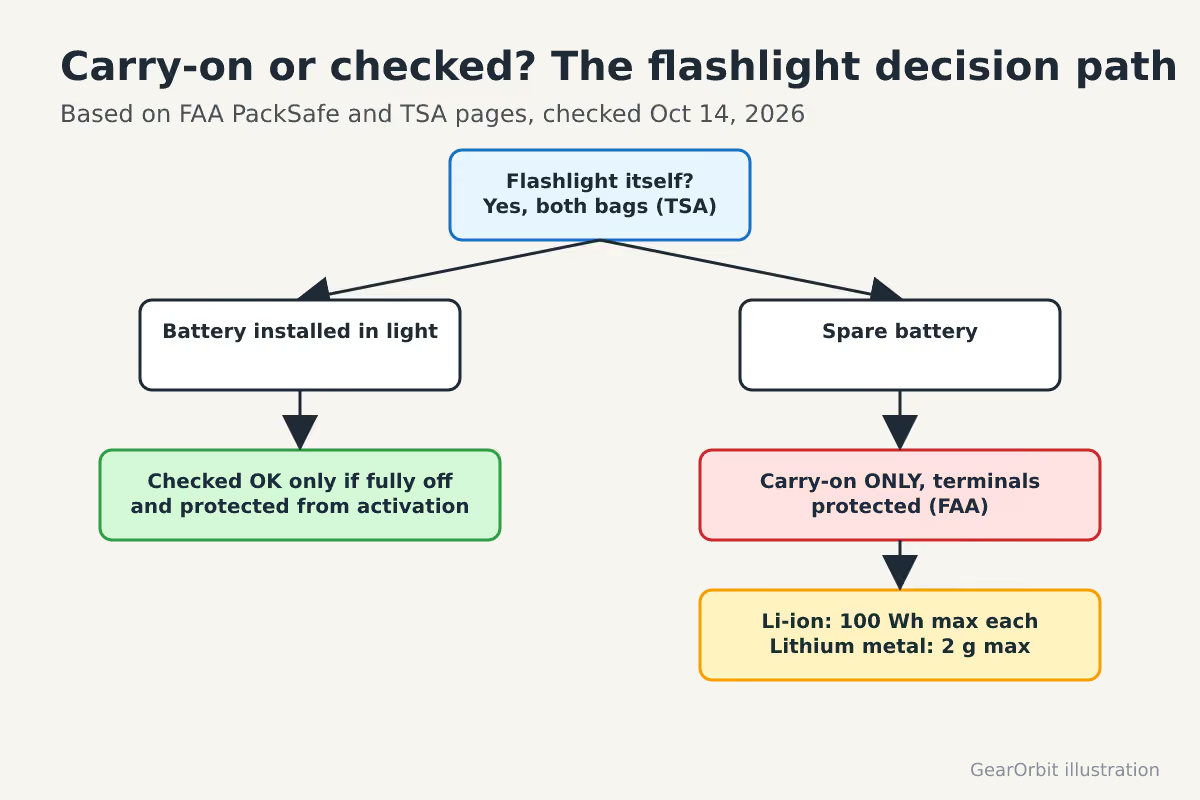
The short answer: TSA says yes, in carry-on and checked bags
On the TSA's flashlights page, both bags get a "Yes". That covers the light itself, from a keychain light to a full-size torch. In my view the more useful question is what's inside the light, so most of this guide covers batteries.
The officer has the final say
Every TSA item page ends with the same line: "The final decision rests with the TSA officer on whether an item is allowed through the checkpoint." I'd treat that as real. Pack so the light is clearly just a light. It should be off, locked out and easy to pull out if someone asks.
Tactical and strike-bezel lights
TSA's flashlight entry doesn't carve out an exception for tactical lights or crenellated bezels, and I couldn't find an official rule either way. So I won't tell you a bezel light will pass, or that it won't. The officer decides. If an aggressive bezel worries you, the low-stress choice is to fly with a plain light.
The battery rules that actually matter (FAA)
The FAA's PackSafe pages set the battery rules, and the TSA's lithium battery page matches them. The FAA's own battery chart even lists "LED flashlights" as an example under lithium metal batteries.
The line I'd remember for a checked bag comes from the FAA's airline passengers and batteries page: "Rechargeable lithium battery-powered devices can be checked only if they are completely powered off and protected from accidental activation while still meeting the Wh restrictions above."
Installed battery vs spare battery
| Item | Carry-on | Checked | Condition | Source |
|---|---|---|---|---|
| Flashlight (any) | Yes | Yes | Officer has the final say | TSA flashlights page |
| Light with Li-ion battery installed | Yes | Yes | Checked only if fully off and protected from accidental activation; 100 Wh or less (101 to 160 Wh needs airline approval) | FAA airline passengers and batteries |
| Spare Li-ion cell (such as 18650 or 21700) | Yes | No | 100 Wh or less each; terminals protected; remove it if the bag is gate-checked | FAA lithium batteries; TSA lithium batteries |
| Spare Li-ion cell, 101 to 160 Wh | With airline approval | No | Max 2 spares per person | FAA lithium batteries; TSA over 100 Wh page |
| Spare lithium metal cell (CR123A, coin cell) | Yes | No | 2 g lithium or less per battery | FAA lithium batteries; TSA |
| Damaged or recalled battery | No | No | Not allowed unless removed or made safe | FAA lithium batteries |
Checked Oct 19, 2026, on the TSA and FAA pages linked here.
Watt-hours: what 100 Wh means and how to work it out
The FAA's formula is Wh = V × Ah. If your cell lists mAh, divide by 1,000 to get Ah.

| Cell (nominal V x rated Ah) | Wh = V x Ah | Under 100 Wh? |
|---|---|---|
| 3.6 V x 3.0 Ah | 10.8 Wh | Yes |
| 3.6 V x 5.0 Ah | 18 Wh | Yes |
| 3.7 V x 27 Ah | 99.9 Wh | Yes, just |
Illustrative arithmetic. Read the label on your own cell.

Lithium metal cells (CR123A, coin cells)
Primary lithium cells have no Wh value. The FAA limit is 2 g of lithium per battery. The TSA's page for batteries over 100 Wh adds that spare lithium metal batteries of 2 to 8 grams need airline approval, but that's far bigger than a flashlight cell. Most cells don't print their lithium content, so if you're unsure, I'd check the maker's datasheet.
Damaged or recalled batteries
These aren't allowed in either bag. A dented, swollen or recalled cell stays home.
Step by step: flying with a flashlight
Flying with a flashlight, step by step
Step 1: Step 1: Check the battery type and Wh on the cell. Step 2: Step 2: Lock out the light using the method in your maker manual. Step 3: Step 3: Put spare cells in a case, retail pack, tape or pouch. Step 4: Step 4: Keep spares in your personal item. Step 5: Step 5: If your bag is gate-checked, move the spares out first. Step 6: Step 6: Check your airline battery page for stricter limits.
Step 1: Check the battery type and Wh
Is it Li-ion (18650, 21700, 14500, or a built-in pack) or lithium metal (CR123A, coin cell)? Read the V and mAh or Wh off the wrapper.
Step 2: Lock out the light
The FAA wants installed devices protected from accidental activation. Some lights have an electronic lockout, and some makers describe a mechanical lockout made by loosening the tailcap. Each light does it differently, so only use the method your maker manual gives, and don't guess.

Step 3: Put spare cells in a case
The FAA says the terminals "must not come in contact with other metal" and lists the ways to do it: "leaving the batteries in their retail packaging, covering battery terminals with tape, using a battery case, using a battery sleeve in a camera bag, or putting them snugly in a plastic bag or protective pouch." For flashlight cells, I'd pick a cheap plastic cell case. It's the tidiest option.

Step 4: Keep spares in your personal item
Put the spares in your personal item, not the roller. Your personal item stays at your seat, and the roller is the bag that might get taken at the gate.
Step 5: If your bag gets gate-checked, pull the spares out
The FAA is direct about this: "When a carry-on bag is checked at the gate or at planeside, all spare lithium batteries and power banks must be removed from the bag and kept with the passenger in the aircraft cabin." American Airlines says the same for its own flights, so they have to come out of any bag going into the hold.

Step 6: Check your airline's own battery page
The FAA notes that airlines can set stricter limits than the federal ones.
Airlines can be stricter. The FAA notes that many airlines set their own limits on battery quantity or Wh. American Airlines says: "If your carry-on bag must be checked, remove any batteries, electronic cigarettes and other restricted items before your bag is checked." British Airways says spare batteries and power banks "must be carried into the cabin in your smaller under-seat item of hand baggage." For any other airline, read its battery page before you fly.
International flights
On international flights, airlines work from the ICAO Technical Instructions and the IATA Dangerous Goods Regulations. IATA's guidance for passengers travelling with lithium batteries (revised for the 2026 regulations) uses the same bands as the FAA: spare cells up to 100 Wh, or 2 g of lithium metal, go in carry-on only, and spares over 100 Wh but no more than 160 Wh need the airline's approval. It also sets two limits the FAA pages don't:
- "Each person is limited to a maximum of 20 spare batteries of any type." The airline can approve more.
- For 101 to 160 Wh spares, it's a maximum of 2 spare batteries per device.
IATA calls the document guidance, not a source of regulatory compliance, so your airline's page still wins. IATA's traveler page puts the gate-check rule plainly: "If your hand baggage is taken at the gate to go in the hold, remove all lithium batteries and devices first."
I didn't check the UK CAA, EU or Transport Canada pages for this guide, so I won't summarize them here. Check the rules for the country you're departing from and your airline before you fly.
Choosing a travel-friendly flashlight
My criteria, in order:
- Built-in USB-C charging. Then you can leave spare cells at home.
- A real lockout, explained clearly in the manual.
- A common cell type, so the Wh value is easy to read and prove.
Lights that meet these criteria are in my roundups of USB-C rechargeable EDC flashlights, travel flashlights for hotel rooms, tiny keychain flashlights and compact everyday-carry flashlights. For power banks and other gadgets, see my battery safety guide for travelers. If you're flying light, I also have a guide to packing a personal item for 7 days.
FAQ
Can you bring a rechargeable flashlight on a plane?
Yes, in either bag. If it's checked, it has to be fully off and protected from switching on. Spare cells go in your carry-on only.
Can you bring a tactical flashlight on a plane?
TSA doesn't have a separate rule for tactical lights, so the officer decides. The battery rules are the same as for any other light.
Can you bring a small or mini flashlight on a plane?
Yes. The same TSA "Yes" applies to both bags. Coin-cell keychain lights fall under the lithium metal rule, which is 2 g per battery.
Can you take a flashlight on a plane internationally, or in Canada?
Usually, yes. IATA's guidance uses the same 100 Wh and 2 g limits and also keeps spare cells out of checked bags. I didn't check Transport Canada's pages, so for Canada check them and your airline. Anywhere else, check the departing country's rules.
Can you bring a torch on a plane?
A torch is the UK word for a flashlight. On US flights the answer is the same: yes, with the battery rules above.
Can I pack spare 18650 batteries in checked luggage?
No. Spare lithium-ion cells go in your carry-on only, with the terminals protected (FAA, TSA).
Do I need to remove the battery from my flashlight?
The FAA text I read doesn't require it. A device can go in a checked bag if it's powered off and protected from activation. Your maker manual or your airline may still recommend taking it out.
Sources and how I researched this
This is a rules guide built only from official pages. I didn't handle or fly with any lights for it. Checked Oct 19, 2026:
- TSA, flashlights
- TSA, lithium batteries 100 Wh or less
- TSA, lithium batteries over 100 Wh
- FAA PackSafe, lithium batteries (terminal protection methods, gate-check rule, Wh = V × Ah, 49 CFR 175.10(a)(18))
- FAA PackSafe, airline passengers and batteries
- IATA, Passengers Travelling with Lithium Batteries guidance document (revised for the 2026 regulations, dated Mar 31, 2026)
- IATA, Safe Travel with Lithium Batteries
- American Airlines carry-on baggage
- British Airways baggage essentials
Rules can change. If an official page disagrees with this guide, go by the official page.
The Weekly Dispatch
Enjoying this article?
Subscribe and get our best gear picks delivered every Sunday morning.
Related Posts
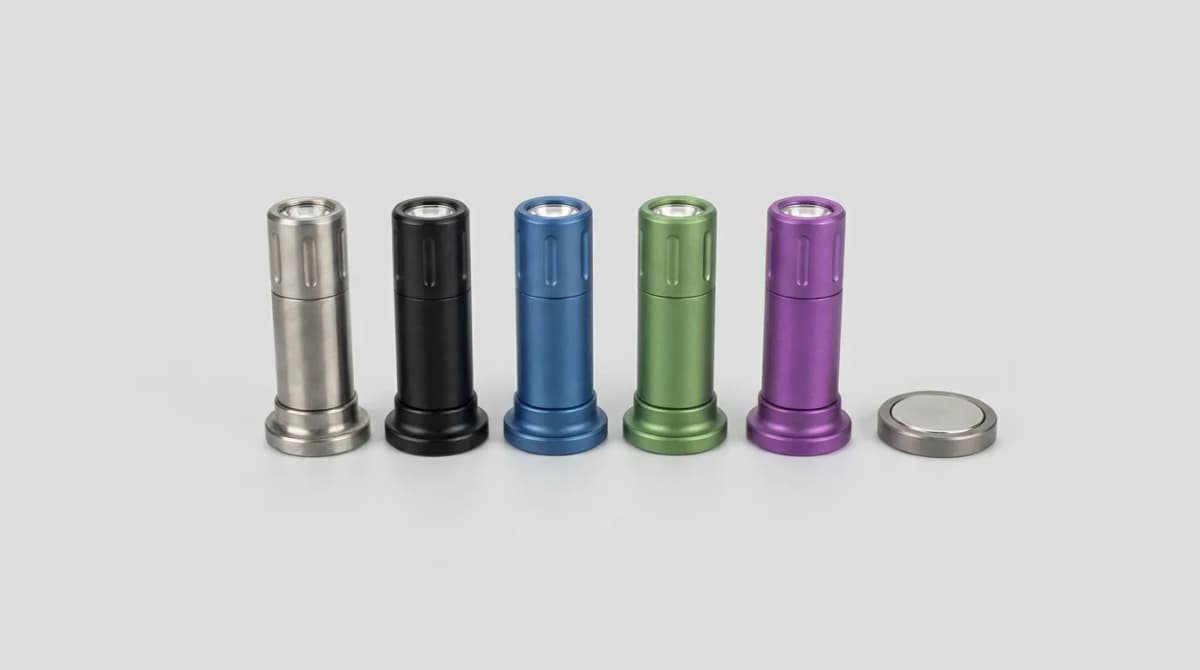
Rodman ED08 2.0: Coin-Size Titanium Light Specs
Rodman's ED08 2.0 is a 36 g Grade 5 titanium keychain light with five colors and a magnetic stand. What changed, what the numbers mean, and who it suits.
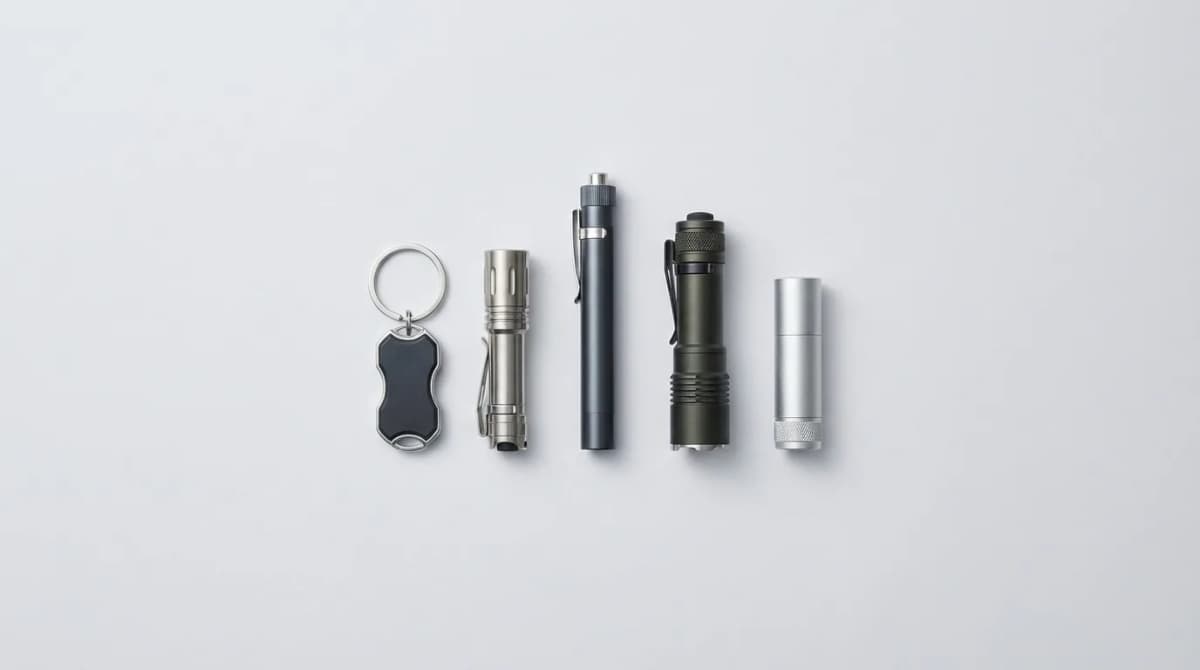
Best Travel Flashlights for Hotel Rooms: Moonlight Picks
Low-lumen moonlight modes for night-time hotel trips, plus enough output for a power cut. Travel flashlights compared by maker specs and carry weight.
USB-C Rechargeable EDC Flashlights (2026): TIP3, FC11, Wedge
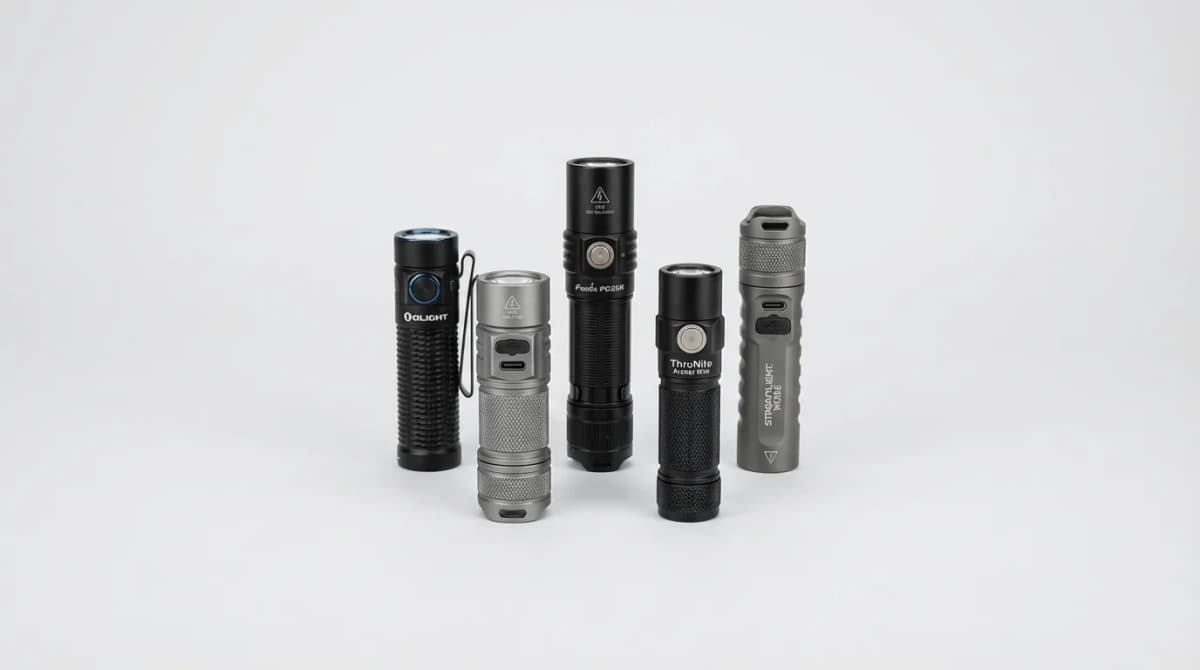
Which EDC flashlights actually charge over USB-C? Nitecore TIP3, Wurkkos FC11 and Streamlight Wedge, plus popular lights that use magnetic chargers instead.
Best Keychain Flashlights (2026): Tiny Lights Under 2 Inches
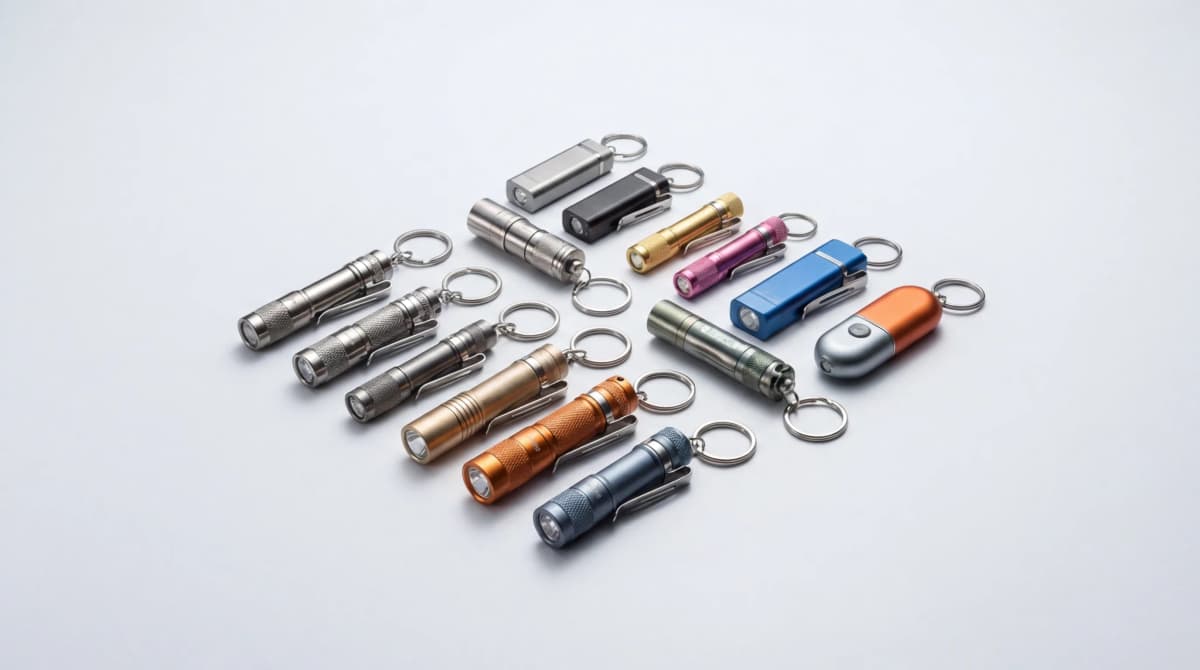
Keychain-size lights compared by maker specs: Olight i3T EOS, Nitecore TINI 2, RovyVon Aurora A1, Fenix E05R and Streamlight Nano. Clip, size and runtime.