Best Travel Friendly Camera Batteries and Chargers
Keep your camera powered on the road with compact chargers, high-capacity batteries, and versatile power solutions designed for travelers.
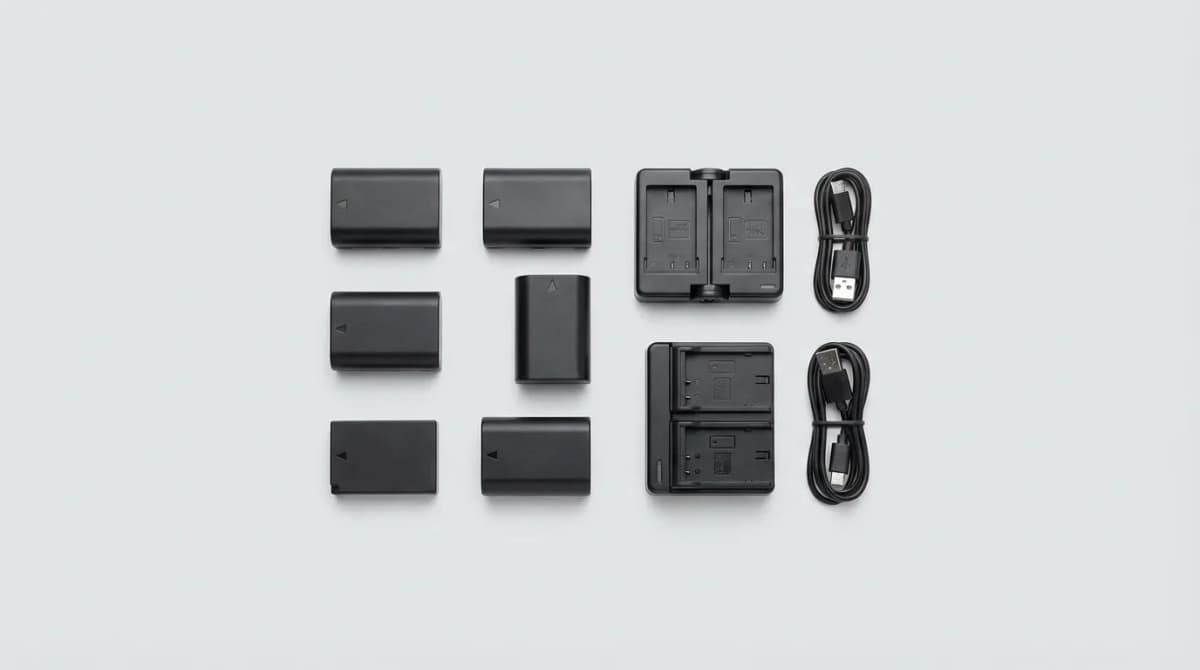
Running out of battery power mid-shoot is one of the most frustrating experiences for any photographer. Whether you are hiking through national parks or documenting street scenes in a new city, your camera needs reliable power. The problem is that traditional charging setups are bulky, slow, and tied to wall outlets.
Quick Picks
Our top recommendations at a glance:
- 1
- 2
- 3
- 4
- 5
Travel-friendly camera batteries and chargers solve this by prioritizing portability, fast charging speeds, and compatibility with modern power sources like USB-C and power banks. The best setups let you charge multiple batteries simultaneously, work with international voltage, and fit easily into a camera bag without adding pounds.
We compared charging solutions across different camera systems to find what actually works for travelers who need to stay powered up without carrying a brick of gear.
Why Standard Camera Chargers Fall Short for Travel
Most cameras ship with basic chargers that were designed for home use, not travel. They are often single-battery chargers with proprietary wall plugs, meaning you need one outlet per battery and potentially multiple adapters for international travel.
The bigger issue is speed. Many stock chargers take 2-3 hours to fully charge a battery, which becomes a problem when you are trying to top off multiple batteries between shoots. If you only have access to power for a short window at a hotel or cafe, slow charging means you are heading out with partially charged batteries.
Size matters too. Traditional chargers with attached cables and bulky transformers take up valuable space in a carry-on. When every cubic inch counts, a charging solution that weighs half a pound and requires its own pouch is a poor trade-off.
Modern USB-C charging eliminates most of these problems. You can use the same compact power adapter that charges your phone and laptop, reduce cable clutter, and charge batteries from portable power banks when wall outlets are not available.
Dual Battery Chargers with USB-C Input
Charging two batteries at once is the single biggest time-saver for travel photographers. Dual chargers let you fully power your kit in the time it would take a single charger to handle one battery.
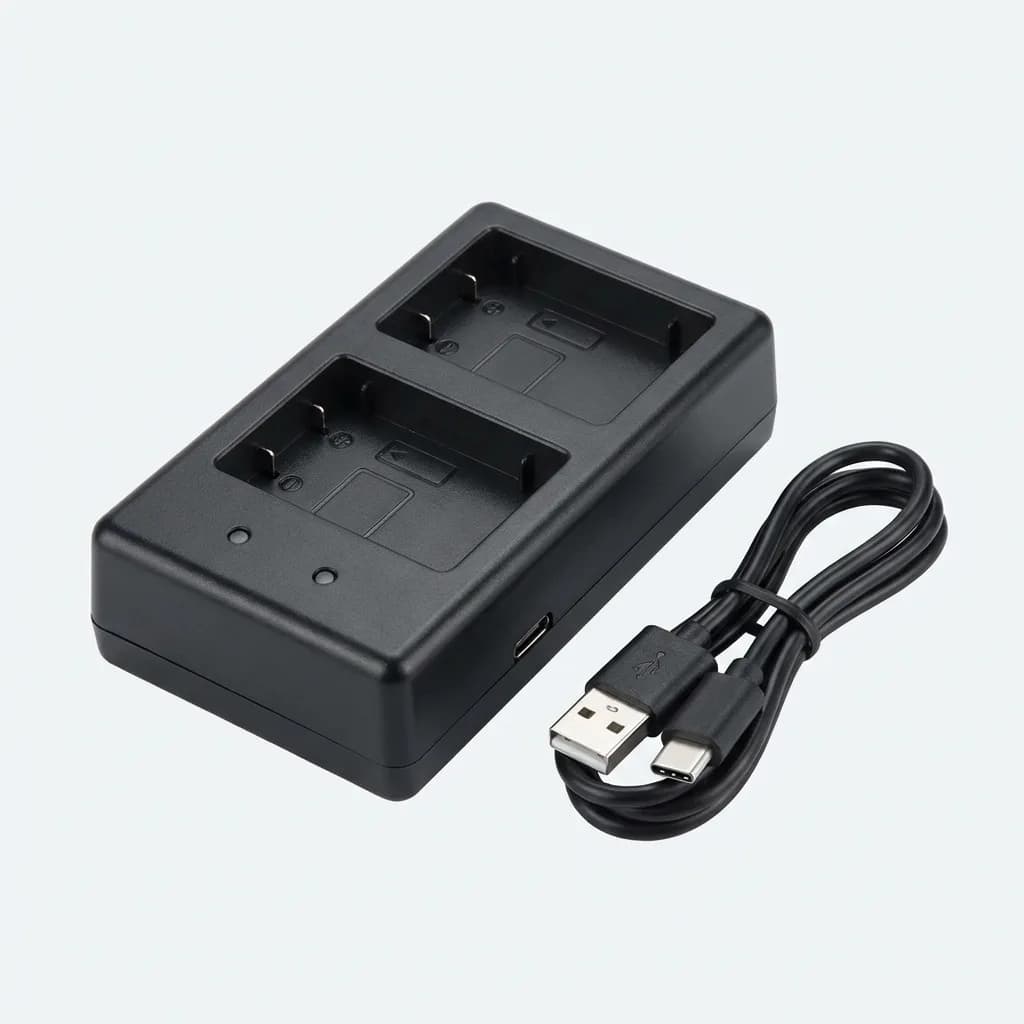
Newmowa Dual USB Charger for Sony NP-FZ100
$17
Charges two Sony batteries simultaneously via USB-C, LED indicators show charge status, compatible with A7 III, A7R IV, A9 series.
Look for chargers with independent charging circuits so each battery charges at full speed, not split power. Cheaper dual chargers often just divide the available current, meaning two batteries take twice as long. Quality models like the Newmowa maintain fast charging speeds for both slots.
USB-C input is non-negotiable. It lets you use any USB-C power adapter, laptop port, or power bank as your power source. This flexibility is critical when traveling internationally or shooting in remote locations where wall outlets are scarce.
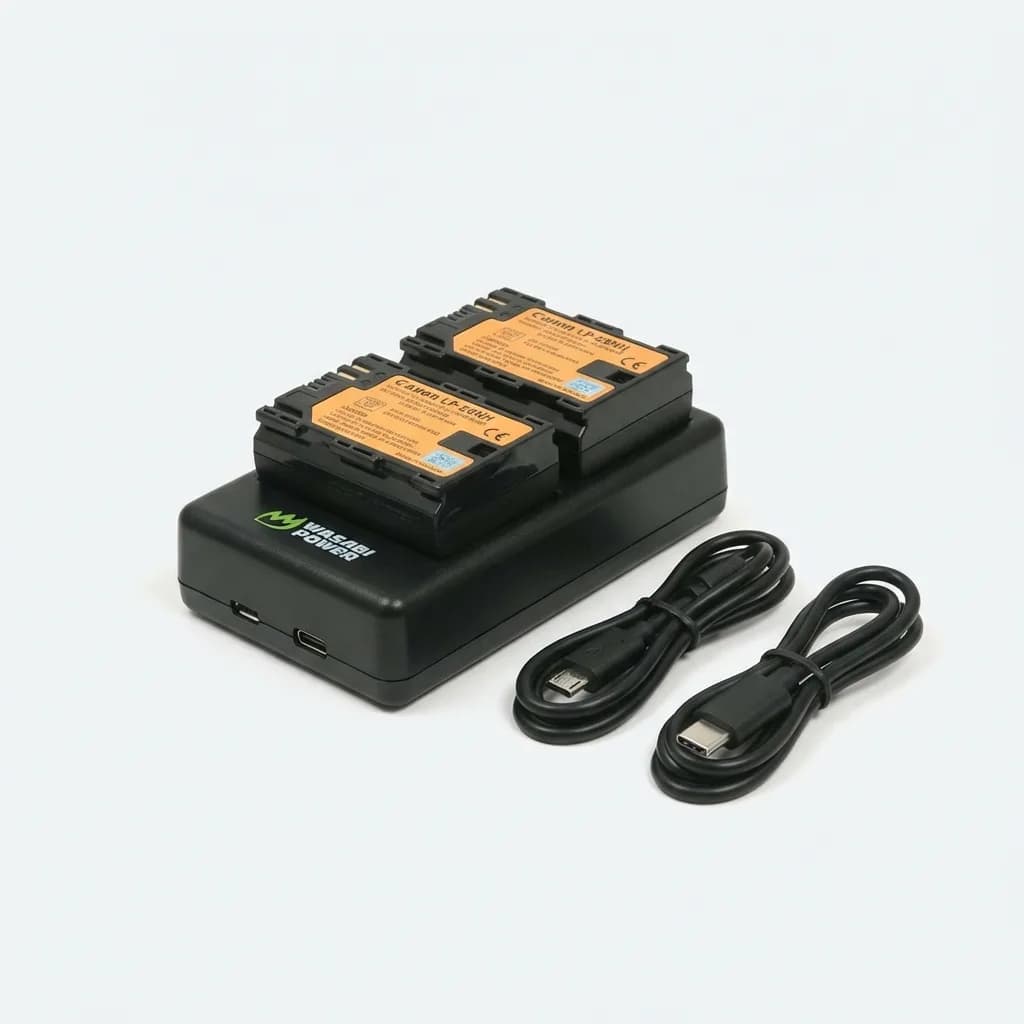
Wasabi Power Dual USB Charger for Canon LP-E6NH
$20
Charges two Canon batteries at once, micro-USB and USB-C inputs, works with EOS R5, R6, 5D Mark IV.
LED indicators are essential for quick status checks. You want to glance at the charger and immediately know if batteries are charging, fully charged, or experiencing an error. Some models use color-coded lights, while others show percentage levels.
High-Capacity Third-Party Batteries Worth Considering
OEM batteries from Sony, Canon, and Nikon are reliable but expensive, typically $70-80 each. Third-party options have improved dramatically, with many now matching or exceeding OEM capacity at a fraction of the price.
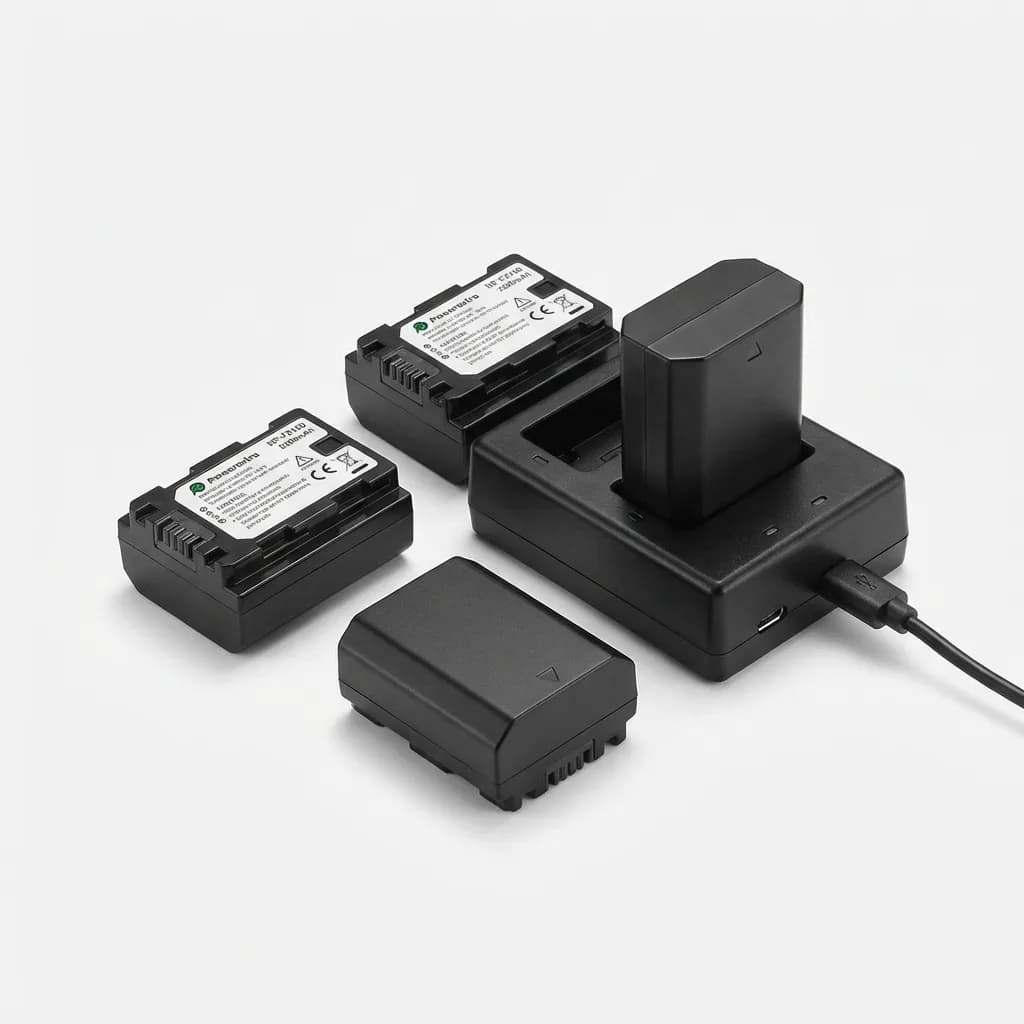
Powerextra 2-Pack NP-FZ100 Batteries
$35
2280mAh capacity, fully compatible with Sony A7 III/IV, A9, includes dual USB charger, chip matches OEM performance.
The key is chip compatibility. Modern cameras communicate with batteries to monitor health, temperature, and charge level. Quality third-party batteries include chips that replicate this communication, so your camera recognizes them as legitimate. Budget options without proper chips may trigger warnings or fail to report accurate battery life.
Capacity is measured in milliamp-hours (mAh). Higher numbers mean longer shooting time. Sony's OEM NP-FZ100 batteries are 2280mAh. Third-party options claiming 3000mAh+ are often overstating capacity, but reputable brands like Wasabi Power and RAVPower stick to realistic specs that match or slightly exceed OEM.
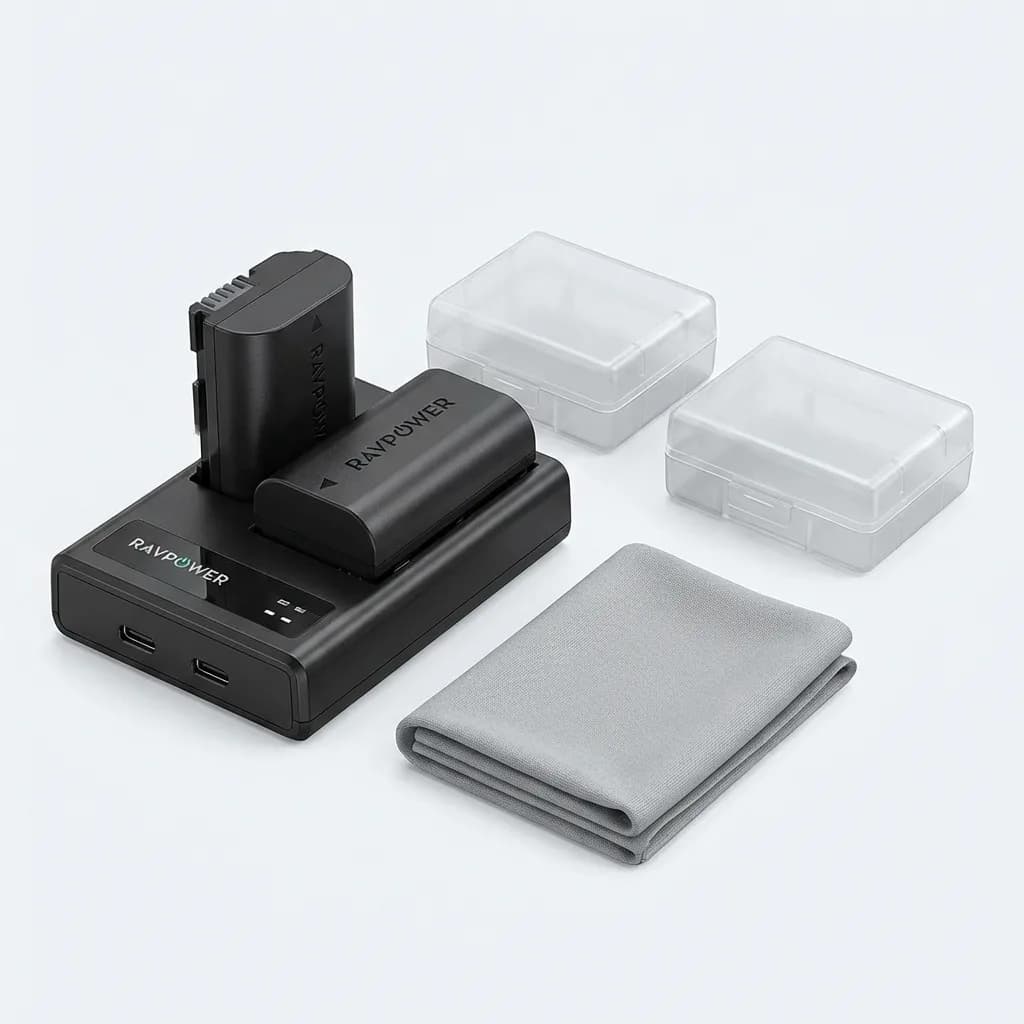
RAVPower LP-E6NH 2-Pack with Charger
$40
2250mAh Canon batteries with dual USB-C charger, works with EOS R5, R6, 90D, includes microfiber cloth and storage case.
For travel, buying a bundle with batteries and a dual charger saves money and ensures compatibility. Most manufacturers test their batteries with their own chargers, reducing the risk of charging issues or incompatible chips.
Power Banks for Charging Without Wall Outlets
Power banks transform how you manage camera batteries on extended trips. Instead of hunting for outlets at airports or cafes, you charge batteries from a portable power bank in your bag.
Not all power banks work equally well for this. Camera battery chargers typically need 5V/2A minimum input to charge at reasonable speeds. Many older or low-capacity power banks only output 5V/1A, which results in painfully slow charging or failure to charge at all.
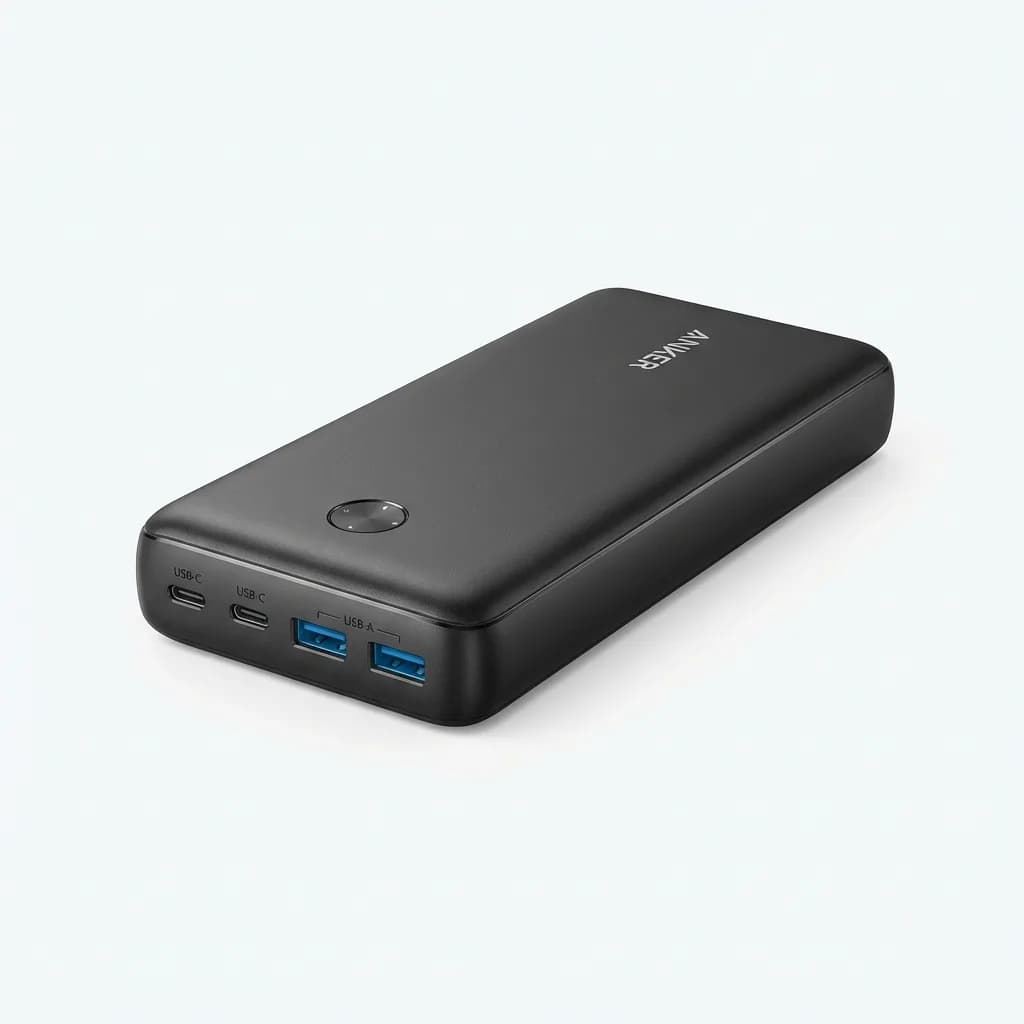
Anker PowerCore III Elite 25600
$110
25,600mAh capacity with 60W USB-C output, charges laptops and camera batteries fast, TSA-compliant for carry-on, 18-month warranty.
Look for power banks with at least 10,000mAh capacity if you want to charge 2-3 camera batteries. A 20,000mAh+ power bank can handle a full day of charging multiple batteries and topping off your phone. Keep in mind that TSA limits carry-on power banks to 100Wh (roughly 27,000mAh at 3.7V), so anything larger will be confiscated at security.
USB-C Power Delivery (PD) is a bonus feature that dramatically speeds up charging. PD-compatible chargers and power banks can deliver higher voltage and wattage, cutting charge times in half. If your dual battery charger supports PD input, pair it with a PD-capable power bank for maximum efficiency.
What About In-Camera USB Charging?
Many newer cameras, including the Sony A7 IV, Canon EOS R6, and Nikon Z6 II, support in-camera USB charging. You plug a USB-C cable directly into the camera to charge the installed battery without removing it.
This sounds convenient, but it has limitations. In-camera charging is slower than external chargers, often taking 3+ hours for a full charge. You also can not use the camera while it charges, which is problematic if you need to review photos or adjust settings.
The real value of in-camera charging is emergency backup. If you forgot your charger or lost it during travel, you can still charge your battery using any USB-C cable and adapter. It is not ideal for routine charging, but it keeps you shooting when you have no other options.
For cameras that support it, in-camera charging works well overnight when you are not using the camera anyway. Just plug in before bed and wake up to a fully charged battery. But during the day when you need fast turnaround, an external dual charger is far more efficient.
Compact Multi-Voltage Chargers for International Travel
If you travel internationally, voltage compatibility is critical. The good news is that most modern USB chargers are multi-voltage (100-240V), so they work anywhere without converters. You only need plug adapters to fit different outlet shapes.
The challenge is finding compact chargers that deliver enough power for fast charging without adding bulk. Wall chargers with folding plugs are ideal because they pack flat and do not snag on other items in your bag.
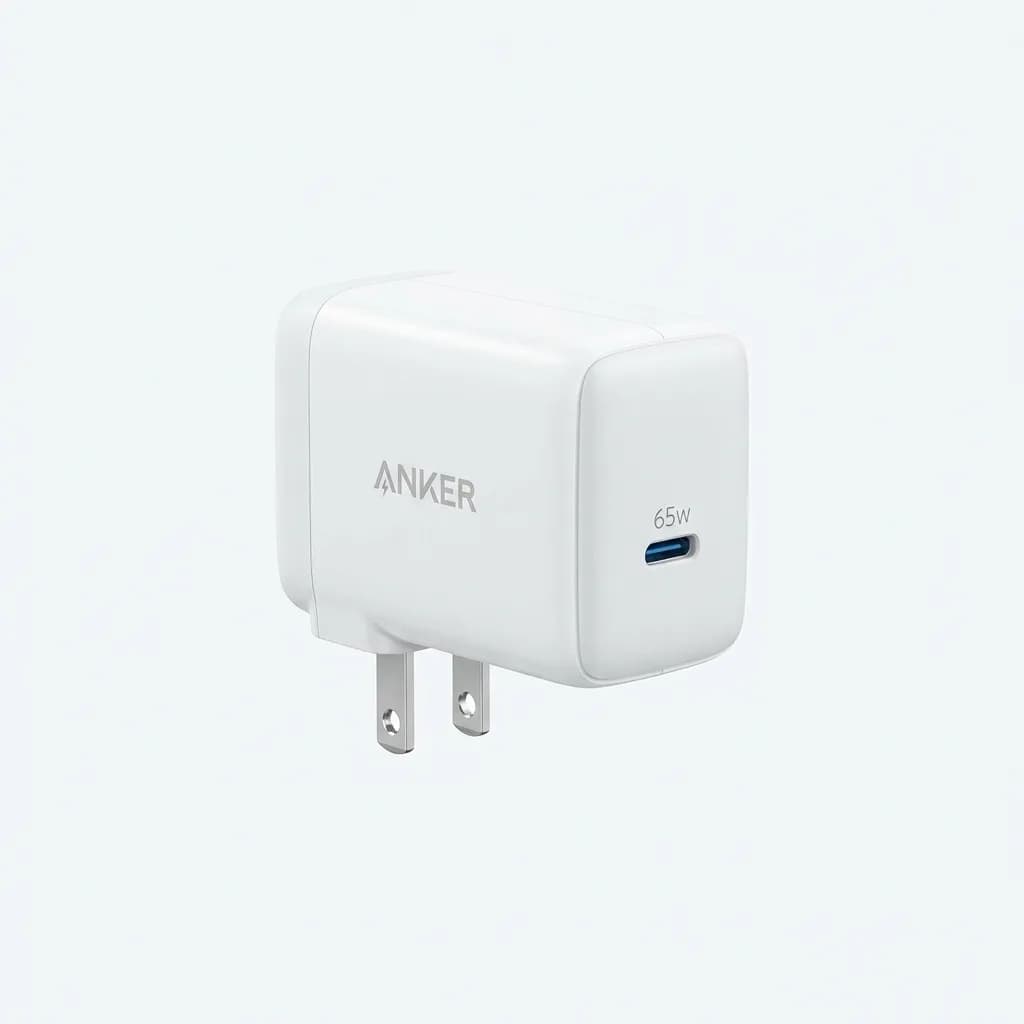
Anker PowerPort III 65W USB-C Charger
$45
65W USB-C output with foldable plug, charges camera batteries, laptops, and phones fast, GaN technology for compact size, multi-voltage 100-240V.
GaN (Gallium Nitride) technology has revolutionized travel chargers. GaN chargers are 30-50% smaller than traditional silicon-based chargers while delivering the same or higher power output. A 65W GaN charger is roughly the size of a deck of cards, yet it can charge a laptop, phone, and camera batteries simultaneously if you add a USB hub.
For minimal setups, a single 30W+ USB-C charger paired with a dual battery charger covers all your needs. You use the same charger for your phone at night and your camera batteries in the morning, eliminating redundant adapters.
How Many Spare Batteries Do You Actually Need?
Battery life varies wildly depending on your camera model and shooting style. Mirrorless cameras with electronic viewfinders and 4K video drain batteries faster than DSLRs or cameras using optical viewfinders.
Sony A7 III shooters typically get 500-700 shots per battery when shooting stills. Heavy video users might drain a battery in under an hour. Canon EOS R5 users report similar performance, while Nikon Z-series cameras tend to be slightly more efficient.
For day trips, two batteries (one in-camera, one spare) is usually sufficient for casual shooting. If you are shooting events, wildlife, or long video takes, three batteries is a safer minimum. Extended multi-day trips without reliable charging access might require four or more.
The key is knowing your shooting pattern. Track how many batteries you use during a typical day at home, then add one extra as a buffer. Overbuying batteries is wasteful, but running out mid-shoot is worse.
Storage and Organization for Travel
Loose batteries rattling around in a camera bag is a recipe for damage and short circuits. Exposed battery contacts can touch metal objects like keys or coins, causing dangerous shorts or fires.
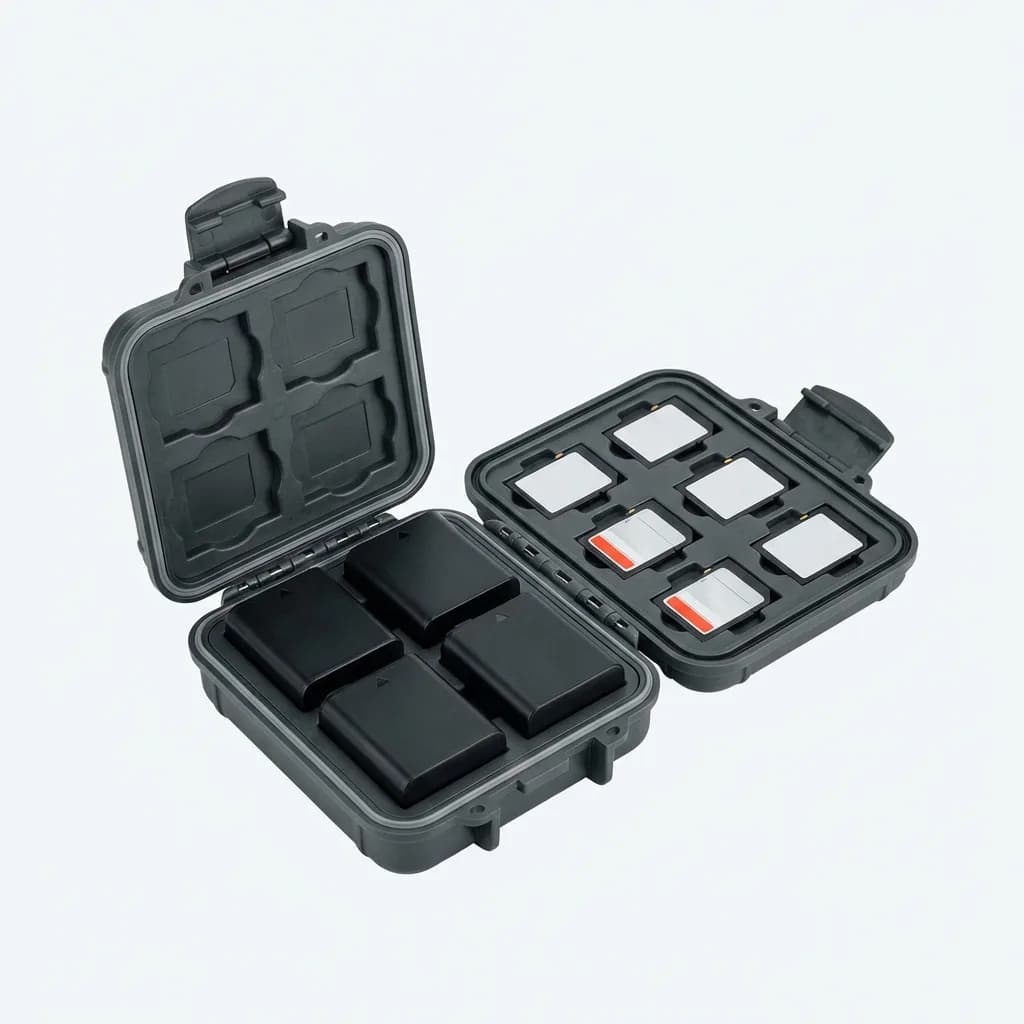
JJC Battery Case for 4 Batteries
$13
Hard shell case holds four camera batteries securely, individual slots prevent contact, includes eight SD card slots, compact and water-resistant.
Battery cases with individual slots keep contacts isolated and batteries protected from impacts. Look for hard-shell cases rather than soft pouches, especially if you check luggage. A hard case can survive a bag being tossed around by baggage handlers.
Some battery cases include slots for SD cards, which is useful for keeping all your camera accessories in one place. Just make sure the case is compact enough to fit in your camera bag without taking up excessive space.
For minimalists, even a simple silicone battery cap that covers the contacts is better than nothing. These slip over the end of the battery and prevent shorts while taking up almost no space.
Charging Strategies for Extended Trips
The biggest mistake travelers make is waiting until all batteries are dead before charging. This creates a bottleneck where you are stuck waiting for hours while batteries charge instead of shooting.
A better approach is opportunistic charging. Whenever you have downtime, even 30 minutes at a cafe or in a taxi, plug in your dual charger and top off partially drained batteries. Modern lithium-ion batteries have no memory effect, so frequent partial charges do not harm battery health.
Prioritize charging your most-depleted battery first. If you have two batteries at 40% and 70%, charge the 40% one while keeping the 70% as your active battery. This ensures you always have maximum total capacity available.
For multi-day backcountry trips without power access, solar chargers are an option, but they are slow and weather-dependent. A large 20,000mAh+ power bank is more reliable and lets you charge batteries inside your tent at night regardless of weather.
Common Mistakes That Drain Batteries Faster
Leaving your camera on standby between shots drains batteries faster than you think. Mirrorless cameras continuously power the sensor and electronic viewfinder even when you are not shooting. Switch your camera fully off during long breaks.
Extreme temperatures kill battery performance. Cold weather reduces capacity by 20-40%, while heat accelerates degradation. Keep spare batteries in an inside jacket pocket in winter to maintain warmth. In hot climates, avoid leaving batteries in direct sunlight or hot cars.
Using battery-intensive features unnecessarily shortens shooting time. Continuous autofocus tracking, high frame rate burst mode, and live view with focus peaking all drain power faster than single-shot AF and optical viewfinders. Adjust your settings based on your current battery level and charging access.
Poorly maintained batteries also underperform. Clean battery contacts with a dry cloth every few months to ensure good electrical connection. Batteries degrade over time, so replace any that no longer hold 80% of their original capacity.
Quick Charging Tips for Airport Layovers
Airports are ideal for topping off batteries between flights, but you need to work fast. Most layovers only give you 1-2 hours of actual charging time after security, bathroom breaks, and boarding.
Bring your dual charger and a long USB cable (6 feet minimum) so you can reach distant outlets. Airport outlets are often located in awkward spots under seats or behind poles. A long cable gives you flexibility to charge while keeping an eye on your gate.
Many airports now have USB charging stations built into seats, but these often output only 5V/1A, resulting in very slow charging. Wall outlets paired with your own fast charger are more reliable. If you have a power bank, use the layover to recharge the power bank itself while your camera batteries charge from it.
Set a timer on your phone so you do not miss your boarding call while focused on charging. Nothing is worse than a missed flight because you were too absorbed in managing batteries.
The Minimal Travel Charging Kit
If you want to travel light, you can cover all your camera charging needs with just three items: a dual USB battery charger, a 30W+ USB-C wall adapter, and one spare battery beyond what came with your camera.
This setup weighs less than half a pound, fits in a small pouch, and handles most travel scenarios. Add a 10,000mAh power bank if you need charging flexibility without outlets, bringing total weight to about one pound.
For extended trips or heavy shooting, scale up to four batteries total and a 20,000mAh power bank. This covers multi-day shoots without reliable charging access while still keeping your kit compact and organized.
The goal is having enough power capacity without carrying redundant gear. Every extra battery and charger adds weight and takes up space that could go toward lenses or other accessories that actually improve your photos.
The Weekly Dispatch
Enjoying this article?
Subscribe and get our best gear picks delivered every Sunday morning.
Related Posts
The Vintage Digicam Trend Explained
Vintage digital cameras from the early 2000s are making a comeback. Here's why photographers are ditching their smartphones for grainy, low-res digicams.

Small Prime Lenses for Travel: Why They Beat Zooms
Small prime lenses deliver sharper images and better low-light performance than zoom lenses while saving critical weight in your travel kit.

Best Lens Filters for Travel Photography
Skip the UV filter debate. These are the lens filters that actually matter for travel photography - polarizers, ND filters, and when each one earns its place in your bag.
Travel Backup Workflow for Photos and Video
A practical guide to the 3-2-1 backup rule for travel creators: SSD selection, cloud sync strategies, and building a redundant workflow that survives theft and failure.